
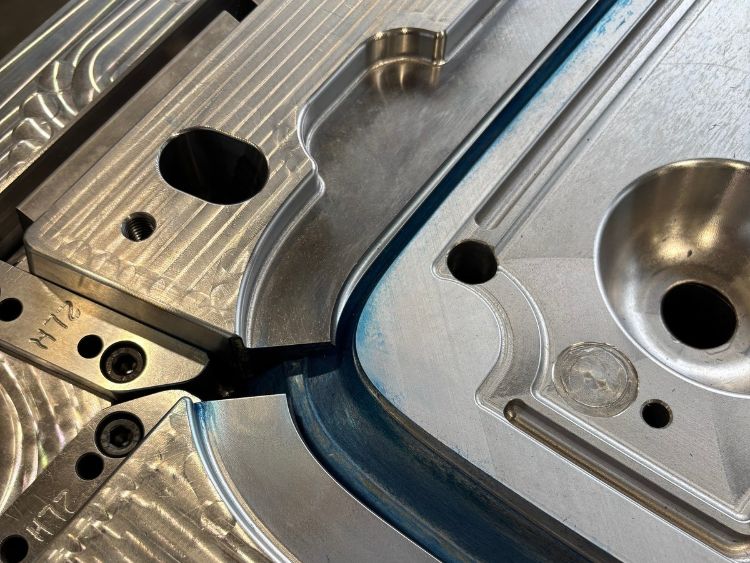
The automotive glass encapsulation process requires specific technologies, highly specialized molding expertise, high-precision molds and equipment, and very careful thermal management to avoid glass breakage during production.
Topics covered in this article:
- What is glass encapsulation and what is it used for?
- Molding technologies for glass encapsulation
- Materials and process specifications
- Required precision and production criticalities
- Application cases: from side windows to panoramic windshields
- Future trends: functional glass and component integration
- FAQ – Automotive Glass Encapsulation
What is glass encapsulation and what is it used for?
Glass encapsulation is one of the most specialized processes in the entire automotive supply chain: it involves injecting a polymer profile directly around the perimeter edge of a glass pane – windshield, rear window, or fixed side windows-creating, in a single operation, the structural gasket that seals and secures the glass to the body. The result is an integrated component, ready for assembly in the production line, which must simultaneously meet aesthetic, structural, and sealing requirements.
The complexity of this process lies not only in the mold. It lies in the interface between two materials with profoundly different physical behaviors-the rigid yet brittle glass, and the molten polymer, injected at high temperature and pressure – which must coexist in the same production cycle without the glass breaking and without the profile exhibiting aesthetic or dimensional defects.
Molding technologies for glass encapsulation
The automotive glass encapsulation process is mainly carried out through two molding technologies:
Thermoplastic injection molding (TPE/TPV /PVC ): The thermoplastic elastomeric material is injected around the glass positioned in the mold. This is the most widespread technology for medium-high production volumes for series automotive glass, due to its cycle speed and dimensional repeatability.
RIM/RRIM reactive molding with polyurethane: The two-component polyurethane is injected in a liquid state and chemically reacts inside the mold. It produces profiles with high flexibility and excellent elastic properties, used primarily for windshields in premium vehicles and applications with high acoustic requirements.
In both cases, the glass is placed in the mold as an insert, held by centering and locking systems that prevent it from moving during injection, and the profile is formed directly on its perimeter surface.
Materials used and process specifications
The choice of glass encapsulation material depends on the functional specifications of the component and the assembly process in the body shop. Commonly used materials include:
- TPE-S / TPV (thermoplastic vulcanized elastomers): flexibility, weather resistance, colorability in gloss or matte black. Reference standard for automotive side and rear windows.
- Plasticized PVC: a historic material in the industry, still used for some applications due to its low cost and workability. It is gradually being replaced by TPE for reasons of recyclability.
- Polyurethane (PU): For applications with higher acoustic and thermal insulation requirements, typically on high-end windshields.
The critical process parameters are the injection pressure and speed which must be appropriately modulated to avoid damage to the glass during encapsulation, the temperature of the injected material and the temperature of the mold must be appropriately controlled to avoid aesthetic defects on the product.
Required precision and production criticalities
The design of automotive glass encapsulation molds is influenced by a variable that doesn’t exist in conventional molds: the presence of a highly fragile insert, the glass. Each sheet of glass has its own dimensional tolerances, much greater than the mold’s tolerances. A well-made mold is characterized by its ability to “adapt ” to the glass insert without damaging it or creating aesthetic defects on the molded part.
The main critical issues in the production of automotive molds for encapsulation are:
- Precision of coupling between the mold parts: any micrometric inaccuracy in the closure translates into burrs on the profile or, in the most serious cases, into forces concentrated on the glass that can cause it to break.
- Glass centering system: the glass must be positioned repeatably within a few tenths of a millimeter at each cycle, using fixed references and locking systems that do not damage the surface or edge treatment.
- Mold thermal management: the temperature of the surfaces in contact with the glass is actively controlled to avoid thermal shock and ensure uniform cooling of the polymer profile.
- Injection system: the position and number of injection points determine the flow path around the perimeter of the glass. An uneven filling can potentially cause glass movement, visible joint lines, and consequent variations in profile thickness.
Application cases: from side windows to panoramic windshields
Automotive glass encapsulation is applied to four main types of glass: front windshields, rear windows, fixed side windows, and panoramic sunroofs. Each application has different specifications in terms of profile geometry, material, color, and sealing requirements.
CA Stampi has developed specific expertise in this process through projects carried out for brands such as Ford, Nissan, BMW, Mercedes, Honda, Toyota, Stellantis, Volvo, with an internal production capacity that includes dedicated presses for functional validation tests of all the molds designed and manufactured.
Future trends: functional glass and component integration
Emerging trends in automotive glass encapsulation reflect the technological evolution of the vehicle. New-generation windshields integrate ADAS sensors, cameras, antennas, and film heaters-elements that must be positioned and protected during the encapsulation process without interfering with the visual or structural profile.
The molding process must therefore evolve to handle multiple inserts within the same cycle, increasingly tighter tolerances on positioning references, and materials compatible with the surface treatments of next-generation glass. The growing popularity of electric vehicles is also leading to a revision of acoustic requirements, with more complex profile geometries to reduce the frequencies typical of electric powertrains.
To learn more about CA Stampi’s expertise in glass encapsulation molds and automotive product industrialization, visit the dedicated sections of the website. An authoritative external technical reference for automotive glass process standards is the documentation published by Glass for Europe, the European association of flat glass manufacturers and the automotive industry.
For a technical evaluation of a glass encapsulation project, the CA Stampi team is available from the concept phase.
For more information, contact our technicians.
FAQ – Automotive Glass Encapsulation
1. What is glass encapsulation and why is it used in the automotive industry?
Glass encapsulation is the process by which a polymer profile is molded directly around the perimeter edge of a window, whether a windshield, rear window, or side window. It creates a single-step seal that seals the glass to the body, eliminating the need for separate gasket installation, improving the appearance of the glass edge, and reducing thermal and acoustic bridges. It is used on nearly all modern production vehicles for reasons of quality, assembly efficiency, and reduction of in-line components.
2. What materials are used for automotive glass encapsulation?
The main materials for automotive glass encapsulation are flexible, weather-resistant, and recyclable thermoplastic elastomers (TPE and TPV), plasticized PVC for traditional, low-cost applications, and two-component polyurethane for premium applications with high acoustic and thermal requirements, typically on high-end windshields. The choice depends on the vehicle specifications, the body shop assembly process, and the OEM’s sustainability requirements, with a growing trend toward TPEs due to their compatibility with end-of-life vehicle recycling processes.
3. Why are glass encapsulation molds more complex than conventional molds?
Molds for encapsulating automotive glass must manage a variable absent from conventional molds: the glass as a fragile production insert with inherent tolerances. The fit between the mold parts must be extremely precise; any inaccuracy in the closure generates burrs or concentrated forces that break the glass. The centering system must position each pane with repeatability of a few tenths of a millimeter. Mold temperature must be actively controlled to avoid thermal shock. The injection system must ensure balanced perimeter filling without visible seams.
4. What is the difference between TPE and polyurethane encapsulation?
Glass encapsulation with TPE uses conventional injection molding: rapid cycles, high repeatability, suitable for high production volumes. The profile is injected molten and solidifies upon cooling. Encapsulation with polyurethane uses reactive RIM molding: the two liquid components are mixed and injected at low pressure, chemically reacting in the mold. It produces profiles with greater flexibility and better acoustic insulation, but requires longer cycles and more complex qualification processes. TPE is preferred for mass-produced automotive glass, while polyurethane is used for premium applications and windshields with high acoustic requirements.
5. How are glass encapsulation molds evolving with electric vehicles and ADAS systems?
The evolution of vehicles toward electric powertrains and assisted driving is redefining the specifications of automotive glass encapsulation molds. New-generation windshields integrate ADAS sensors, cameras, and antennas that must be positioned during the encapsulation process with very tight positioning tolerances. Electric vehicles require profiles with more complex geometries to reduce the acoustic frequencies of the electric powertrain. Sustainability requirements are pushing for materials with higher recycled content. These developments require molds with more complex kinematics, multiple centering systems, and an even more in-depth co-design phase between the OEM, glass manufacturer, and mold maker.
For more information, contact our technicians.